When “Proof” Isn’t Proof
The Parvo Papers and the Familiar Virus Playbook

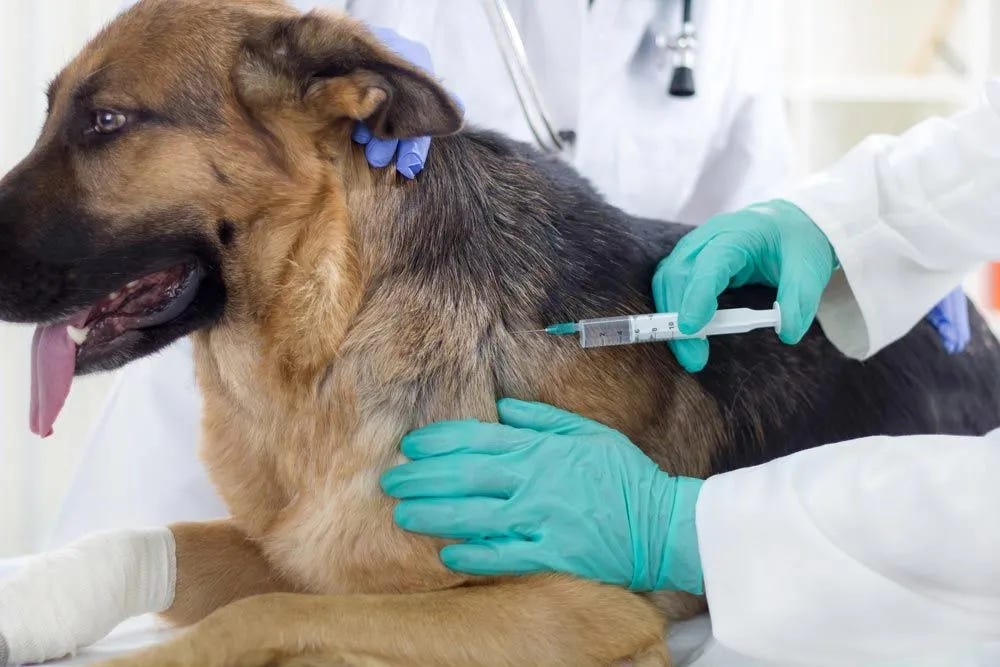
Every so often, someone does the tedious, unglamorous work of actually reading the studies everyone else just cites. Unbekoming has done exactly that in “The Parvo Papers”—and what falls out is uncomfortably familiar to anyone who’s followed the last few years of “trust the science” theater.
You can read the full piece here (and you should, before the experts tell you what it really says):
👉

What follows is the short version—with the connective tissue spelled out.
The Claim That Launched a Thousand Needles
We’re told canine parvovirus was “proven” in the late 1970s and early 1980s by a small set of foundational experiments. These papers are still cited today as definitive proof that a virus causes the disease known as “parvo.”
Unbekoming’s point is not subtle: they don’t prove that at all
pasted
.
Instead, they follow a pattern that looks eerily similar to human virology experiments:
No purified virus
No clear isolation
No natural route of exposure
And no way to tell whether illness came from a virus, a toxic mixture, or an immune-disrupting intervention
Sound familiar yet?
The Core Methodological Problem (a.k.a. “Soup Is Not Isolation”)
In both cornerstone parvo studies, researchers didn’t administer a purified viral particle. They injected or administered cell-culture supernatant—a biological stew containing:
Animal cell debris
Growth media
Antibiotics and antifungals
Fetal serum
And allegedly, a virus
Once you introduce a mixture like that into an animal—especially via unnatural routes like intravenous injection—you’ve already blown the experiment.
If illness follows, you cannot say:
What caused it
Whether a virus played any role
Or whether the immune system simply reacted badly to injected junk
This is not proving causation. It’s creating ambiguity and then declaring victory.
The Detail That Should Have Ended the Debate (But Didn’t)
Here’s the part that should make anyone pause.
In the most cited parvo challenge study, only the dogs that were recently vaccinated became seriously ill after exposure.
The unvaccinated dogs? They showed no clinical disease
pasted
.
The authors even admit this in plain language:
“Significant neutropenia and clinical illness were recorded only in dogs vaccinated with DHL prior to CPV challenge.”
Read that again—slowly.
Illness required vaccination plus exposure. Exposure alone didn’t do the job.
Instead of stopping and asking the obvious question—is vaccination a causal factor?—the authors waved it away as “premature speculation” due to small sample size.
Which is scientific shorthand for: please don’t look here.
This Is the Same Pattern We’ve Seen Before
If this structure feels familiar, it should.
Human experiments use cell cultures and genetic fragments
Animal experiments use culture soup and artificial exposure
Disease appears only under certain stressed or pre-conditioned states
Vaccination status is treated as background noise, not a variable
And when illness appears after vaccination?
That’s framed as tragic coincidence—never a hypothesis worth pursuing.
In parvo research, just as in human virology, the virus is assumed guilty from the start, and every outcome is forced to fit that assumption.
Why This Matters Beyond Dogs
This isn’t really about puppies.
It’s about how “settled science” is manufactured:
Weak studies become citations
Citations become doctrine
Doctrine becomes policy
And policy becomes immune to scrutiny
Once that loop closes, pointing out flaws is treated as heresy rather than due diligence.
Unbekoming’s essay matters because it reopens a case that was never properly closed—and shows that the evidentiary standards collapse the moment you stop nodding along.
A Simple Question No One Wants to Answer
If a virus truly causes a disease, it should be possible to show:
A clearly isolated agent
Causing the same disease
In healthy, unvaccinated hosts
Via natural exposure
The parvo papers don’t do that.
What they do show—quietly, inconveniently—is a vaccination connection to illness that has been ignored for over forty years.
That’s not anti-science.
That’s unfinished science.
And unfinished science should never be treated as gospel—no matter how many needles depend on it.
I read this essay carefully and agree with one narrow point: the early CPV challenge studies (Robinson 1980; Potgieter 1981) were small and methodologically imperfect by modern standards. That is true. But the essay repeatedly turns limitations into invalidation, and that move does not logically follow.
A few specific issues:
1. Early studies ≠ entire evidentiary basis
The essay treats two early challenge papers as if they are the sole foundation for the claim that CPV causes disease. That framing is inaccurate. Those studies were early links in a longer causal chain, not the chain itself. Even if both were fatally flawed (they are not), that would not invalidate decades of subsequent evidence involving transmission dynamics, immunity, protection, and reproducibility across different settings. Freezing the evidentiary timeline at 1980–81 is a historical truncation, not a scientific argument.
2. “Unnatural routes” do not make experiments meaningless
The criticism that intravenous or intranasal routes are “unnatural” confuses transmission studies with pathogenesis studies. An experiment does not have to model every step of natural exposure to test whether an agent can cause disease once present in the host. Different experiments test different links in causation. An IV challenge cannot establish fecal-oral transmission, but it can test systemic pathogenic potential. Declaring such experiments “irrelevant” is a category error.
3. The vaccination finding is misinterpreted
The Potgieter result is interesting and worth discussion, but the essay overstates what it shows. The key facts are:
• Vaccination alone did not cause illness.
• Virus challenge alone produced infection without severe disease.
• Severe disease required both recent vaccination and viral challenge.
That pattern supports immune modulation or timing effects; it does not invert causation or show vaccination as the primary cause of disease. Demonstrating that one factor modifies severity is not evidence that the other factor is irrelevant.
4. Small samples cut both ways
The essay argues that the vaccinated/unvaccinated contrast is “too clean to ignore,” yet elsewhere dismisses unfavorable findings because of small sample size. You cannot simultaneously argue that small numbers are disqualifying and that a result drawn from those same small numbers is definitive when it suits the narrative. Methodological caution has to be applied symmetrically.
5. “Symptoms resemble poisoning” is not causation
Shared symptoms do not establish shared causes. Many insults—infectious, toxic, ischemic—produce vomiting, diarrhea, and leukopenia. What matters is mechanism, reproducibility, and transmission dynamics. The essay relies on clinical similarity while bypassing differences in pathology, spread, and immunity that distinguish toxic exposure from infectious disease.
6. Correlation is repeatedly treated as explanation
The kibble timeline argument is purely correlational. Industrial pet food existed well before the CPV emergence, mycotoxin outbreaks are sporadic rather than synchronized, and CPV outbreaks occur in contexts that do not map cleanly onto a single feed source. Suggesting a dietary contribution to vulnerability is reasonable; presenting diet as a replacement explanation without controlled evidence is not.
7. The essay quietly shifts from critique to denial
The strongest claims are not about parvovirus at all but about virology in general (“no virus has ever been purified or shown to cause disease”). That is not a conclusion derived from the two papers under discussion; it is an imported premise. Once that premise is assumed, every experimental imperfection becomes proof of nonexistence. That is circular reasoning, not skepticism.
In short, pointing out limitations in early studies is legitimate. Concluding from those limitations that viral causation was “never established,” that vaccines or kibble are the primary drivers, or that virology as a whole rests on illusion does not logically follow. The essay substitutes narrative coherence for causal demonstration, and rhetorical confidence for evidentiary balance.
Skepticism should narrow uncertainty, not widen it by discarding entire bodies of evidence on the basis of selectively interpreted flaws.