The Strongest AI-Driven, Conversation-First Language Apps
(What They Cost + What They Actually Teach)

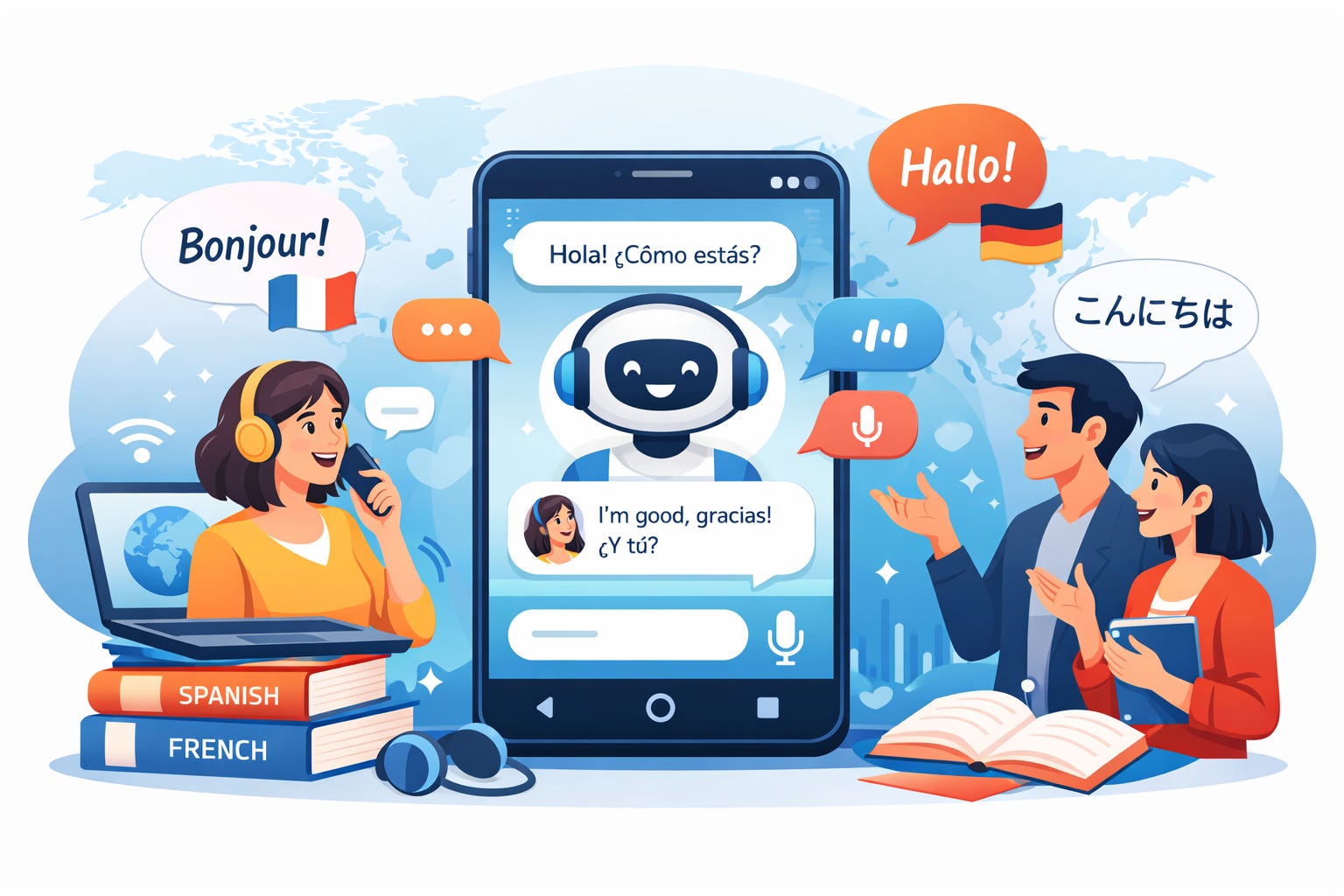
Duolingo Max
Conversation style: Guided AI role-play inside structured lessons
Best for: Beginners → early-intermediate who want guardrails
Cost: ~$168/year (US) for Max tier (varies by region)
Languages covered (40+):
Spanish, French, German, Italian, Portuguese, Dutch, Swedish, Norwegian, Danish, Polish, Czech, Hungarian, Romanian, Russian, Ukrainian, Greek, Turkish, Arabic, Hebrew, Hindi, Bengali, Chinese (Mandarin), Japanese, Korean, Vietnamese, Thai, Indonesian, Swahili, Irish, Welsh, Scottish Gaelic, Hawaiian, Navajo, Yiddish, Latin — plus a few novelty languages.
Reality check:
Great breadth. The AI “conversation” is controlled and polite—think language bowling with bumpers. Useful, but not wild.
Praktika
Conversation style: Open-ended AI dialogue with “tutor personas”
Best for: Speaking reps without pressure
Cost: Typically $9.99/month or ~$49.99/year
Languages covered (major focus):
English, Spanish, French, German, Italian, Japanese, Korean
Reality check:
Excellent for talking a lot. Less strong for grammar structure. Like a gym buddy who never corrects your squat form unless it’s catastrophic.
Speak
Conversation style: Speaking-first AI tutor with corrective feedback
Best for: Absolute beginners who freeze when speaking
Cost: ~$20/month or ~$99/year
Languages covered:
English, Spanish, French, Italian, Japanese, Korean
Reality check:
Confidence-builder extraordinaire. You may outgrow it once you want arguments, humor, or nuance.
Memrise + MemBot
Conversation style: AI chatbot layered onto phrase-based learning
Best for: Practical phrases + contextual practice
Cost:
~$24.99/month
~$61.99/year (often discounted)
~$164.99 lifetime
Languages covered (~35 official + community):
Spanish, French, German, Italian, Portuguese, Dutch, Swedish, Norwegian, Danish, Finnish, Polish, Russian, Ukrainian, Greek, Turkish, Arabic, Hebrew, Persian, Hindi, Bengali, Tamil, Japanese, Korean, Chinese (Mandarin & Cantonese), Vietnamese, Thai, Indonesian, Malay, Swahili, Zulu, Afrikaans — plus community courses that go way off the map.
Reality check:
Less “freeform conversation” than Praktika, but much stronger real-world phrasing. Solid middle ground.
ELSA Speak
Conversation style: Pronunciation and spoken clarity coaching
Best for: Sounding natural in English
Cost:
~$59.99/quarter
~$159.99/year
Languages covered:
English only (by design)
Reality check:
This is a speech coach, not a conversational sparring partner. Pair it with another app unless you enjoy talking at mirrors.
HelloTalk
Conversation style: Real humans (text, voice, rooms) + light AI assist
Best for: Actual conversation in almost any language
Cost: Free tier available; VIP optional
Languages covered:
260+ languages, including rare and regional ones—if humans speak it, it’s probably here.
Reality check:
Unmatched range. Also includes… humans. Which means brilliance, chaos, flirting, ghosting, and unsolicited opinions. Proceed with adult supervision (your own).
Babbel
Conversation style: Structured dialogues (less AI, more curriculum)
Best for: Adults who want practical spoken language
Cost: Frequent promos; lifetime often advertised around $199
Languages covered (14):
English, Spanish, French, German, Italian, Portuguese, Dutch, Swedish, Norwegian, Danish, Polish, Russian, Turkish, Indonesian
Reality check:
Not an AI playground, but extremely solid if you want conversations that resemble real life rather than chatbot improv theater.
Quick Decision Grid (So You Don’t Overthink This)
Wide language choice + AI: Duolingo Max, Memrise
Maximum speaking reps: Praktika
Beginner confidence: Speak
English pronunciation: ELSA Speak
Rare languages / real people: HelloTalk
Serious adult structure: Babbel
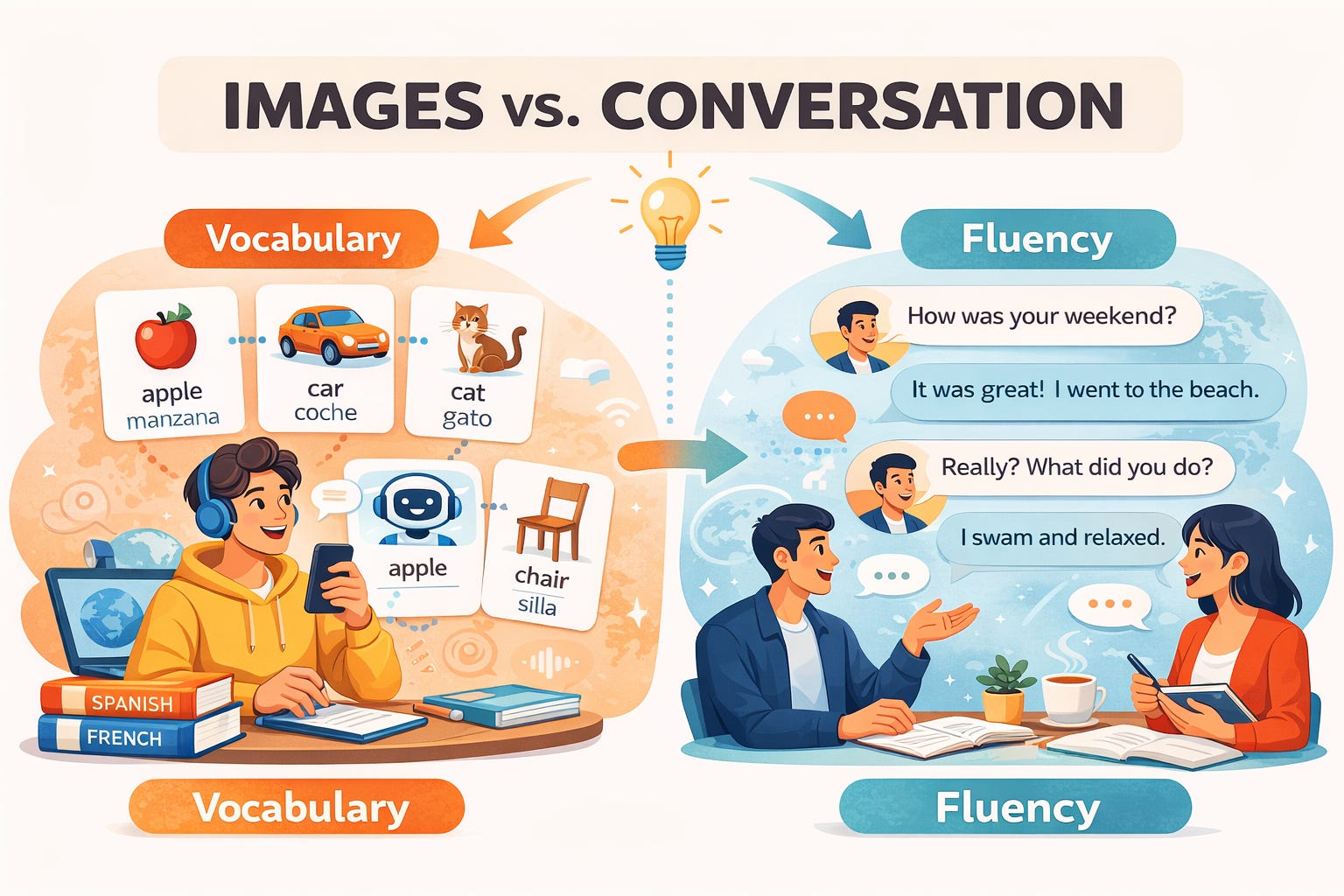
Bonus Section: Images vs. Conversation — What Actually Helps You Learn?
One quiet dividing line among AI language apps is how much they rely on images to teach words and meaning. Some are unapologetically visual. Others assume you’re ready to learn through context, speech, and repetition alone.
This isn’t just a design choice — it reflects very different theories of how adults acquire language.
Why images matter (sometimes)
Images are excellent for:
Concrete nouns (apple, train, chair)
Early vocabulary acquisition
Fast recall without translation
Beginners who think visually
They’re much weaker for:
Abstract concepts
Verbs and tense
Idioms and humor
Real conversational flow
AI conversation tools often reduce image use on purpose, because once you’re speaking, meaning has to live in context — not flashcards.
How image-driven are these apps, really?
Visual reliance by app
AppImage Use LevelHow Images Are UsedDuolingo MaxVery HighCore mechanic: word–image matching, icons, cartoonsMemrise (+ MemBot)HighImages + short videos tied to real-world phrasesBabbelModerateOccasional visuals to anchor meaningSpeakModerate–LowUI cues; speaking and feedback dominatePraktikaLowConversation-first; images mostly cosmeticELSA SpeakVery LowPronunciation visuals only (mouth, waveforms)HelloTalkIncidentalImages only if humans share them
The hidden tradeoff no app advertises
Image-heavy apps excel at starting a language
Conversation-heavy apps excel at using a language
But there’s a catch:
The more an app leans on images, the longer it can delay the discomfort of real conversation.
That’s comforting — and sometimes counterproductive.
Many learners feel “progress” in image-driven apps long after they should already be struggling through imperfect speech.
The practical takeaway
If you’re a true beginner:
Start with image-heavy tools (Duolingo, Memrise) to build a mental lexicon quickly.If you’re transitioning to fluency:
Shift toward AI conversation tools (Praktika, Speak) where images fade and context takes over.If you’re serious about real-world use:
Images should disappear almost entirely — replaced by conversation, mistakes, and repair (HelloTalk or real humans).
Bottom line:
Images help you recognize a language.
Conversation teaches you to own it.
If you want, I can:
Rewrite this bonus section to be more academic or more polemic
Add citations to cognitive science on image-based learning
Tailor the takeaway to a specific language (e.g., why images matter more for Japanese than Spanish)
Just say the word — preferably in a foreign language you’re trying to learn.