Before We Rush to Judgment
The Girls’ School Bombing at Minab — Before the Media Locks in the Verdict

Over the past week many readers have probably seen the disturbing headlines circulating in major outlets about the bombing of a girls’ school in Iran. The story has been presented in a way that strongly implies American responsibility, and the emotional impact of the images has understandably led many people to assume the matter is already settled.
But as with many stories emerging from the fog of war, the early narrative may not be the whole picture.
Below I’m sharing an excerpt from Jeff Childers’ Coffee & Covid newsletter that raises questions about how the story has been framed and what important context has been omitted. Childers points out several details that complicate the prevailing narrative—including the school’s proximity to an Iranian Revolutionary Guard naval complex and the broader pattern of civilian targets being struck throughout the conflict.
He also includes commentary from Iranian dissidents themselves, some of whom argue that the missile that struck the school may not have been American at all but an Iranian misfire.
But even if the final investigation were to conclude that the missile was American, there are still questions that deserve to be asked. Why was the school located immediately next to a sensitive military installation, reportedly separated from the base only by a fence? And why were children attending classes at that particular school when Iran had already closed schools elsewhere because of the war?
None of this proves a final answer about what happened in Minab. But it does serve as a reminder that in wartime—especially in an era of instantaneous media narratives—it may be wise to pause before accepting the first version of events as the definitive one.
Here is Childers’ analysis.
☕️ MRS. MAGOO ☙ Friday, March 13, 2026 ☙ C&C NEWS 🦠
The Times cheerleads Iran’s civilian bombings as ‘strategy’ while calling one US accident a war crime; Florida voting bill, SAVE Act; the Ninth Circuit’s most explicit, R-rated dissent ever; and more.
Mar 13, 2026
Good morning, C&C, it’s Friday, the 13th! Meow. 🐈⬛ Your spooky roundup includes: The New York Times published its tenth breathless article about one Iranian school — while literally cheerleading Iran’s deliberate bombing of hotels, airports, and drinking water across six countries. We have receipts. Plus, Florida just passed proof-of-citizenship voting and the SAVE Act heads to the Senate. And a Ninth Circuit judge opened his dissent with ‘‘swinging peckers’— and then intellectually demolished 28 colleagues who sniffed smelling salts about it. Either way, NOBODY wants to see that. Sometimes my job is just TOO much fun. Happy Friday the 13th.
⛑️ C&C ARMY BRIEFING — IRAN WAR UPDATE ⛑️
You won’t believe how bad the Times was this time. It might as well be launching Iran’s missiles for it at this point. On Wednesday, the New York Times ran a treasonous story —the latest in a treacherous series— headlined, “U.S. at Fault in Strike on School in Iran, Preliminary Inquiry Says.” The strike is old news, still debated— but the Times just won’t let go of it, and the most horrifying part is everything else the moronic Times is deliberately ignoring.
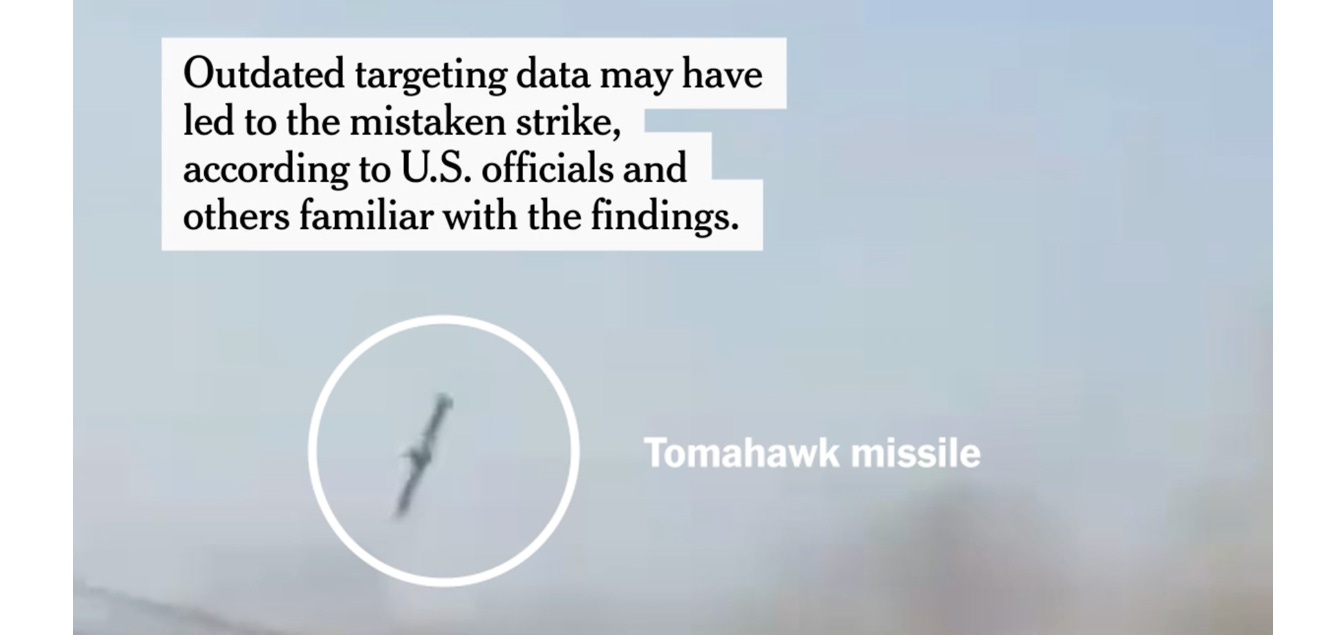
The story begins with a horrifying error. Somebody, somewhere, had blundered. On February 28th —the first chaotic day of the war— an errant missile fell like an avenging angel on an all-girls’ grade school in Minab, a small coastal town sitting right on the war-torn Strait of Hormuz in southeastern Iran. Scores of children were instantly slain. The Iranian propaganda machine instantly cranked into high outrage gear, and I’m not referring to the Times (yet).
A furious debate ensued over whose missile it was —the U.S., Israel, or Iran’s— which still remains unsettled.
Although Iran is an active war zone and is closed to journalists, the Times somehow received minute-by-minute, high-resolution photos and videos of the strike’s immediate aftermath, the grave digging, the burials, the grieving parents, and the ongoing community memorials, from a variety of angles and compositions that would make a team of professional wedding photographers jealous, including multiple overhead drone shots and so on.
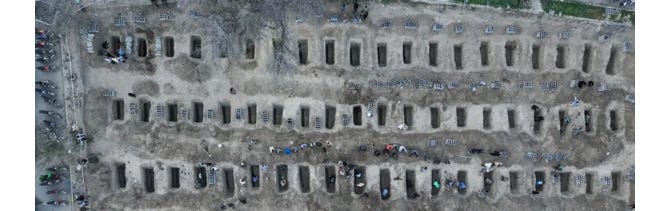
It has never said, not a single time, how it got those images. Sources.
Since the strike, the Times has published at least ten separate articles about the Minab school, plus a full episode of its flagship “The Daily” podcast, all building methodically toward the same baked-in conclusion that Iran’s war propagandists have been arguing since ten seconds after the missile hit: America did it. Nearly every day, a Times reporter hounds President Trump at a press conference somewhere: but what about the GIRLS’ SCHOOL?
On March 5th: “Analysis Suggests School Was Hit Amid U.S. Strikes.” March 8th: “U.S. Tomahawk Hit Naval Base Beside Iranian School, Video Shows.” March 9th: “Missile Appears to Be U.S.-Made.” March 11th: “U.S. at Fault, Preliminary Inquiry Says.” Each headline ratcheted the accusation a little tighter, like a prosecutor laying out exhibits before closing arguments.
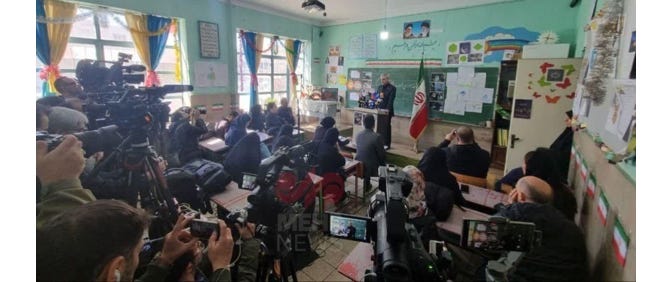
The wall-to-wall coverage had its impact. 120 Democrat lawmakers wrote War Secretary Hegseth demanding that it be “investigated as a possible war crime” — even before the DoD’s own investigation is finished. It has only been two weeks. During the war. They are pretty busy right now, and it’s not like we can get in there and test the missile fragments.
🚀 Oh, how the Times lies. It lies, and lies, and lies. It’s not even clever about it. In the second graph of Wednesday’s story, the Times blithely concluded that, “the strike was the result of a targeting mistake by the U.S. military, which was conducting strikes on an adjacent Iranian base of which the school building was formerly a part.”
Remember: the US military has not yet concluded it was one of our missiles. But set that aside. Let’s assume, for the sake of argument, the Times is right. That one phrase, “an adjacent Iranian base,” is a whole story of its own. A story the Times has avoided telling.
The base is the Sayyid al-Shuhada military complex— the headquarters of the Asif Brigade of the IRGC Navy. It’s not some random army outpost. It is an IRGC Naval command headquarters on Iran’s most strategically critical coastline overlooking the Strait of Hormuz. The school building’s history makes it even more damning.
According to open-source satellite imagery, the school was originally walled inside the IRGC compound as recently as 2013. In 2016, they built a fence between the base and the school, a thin facade allowing the Times to mendaciously call it “adjacent to” the base instead of “part of” the base.
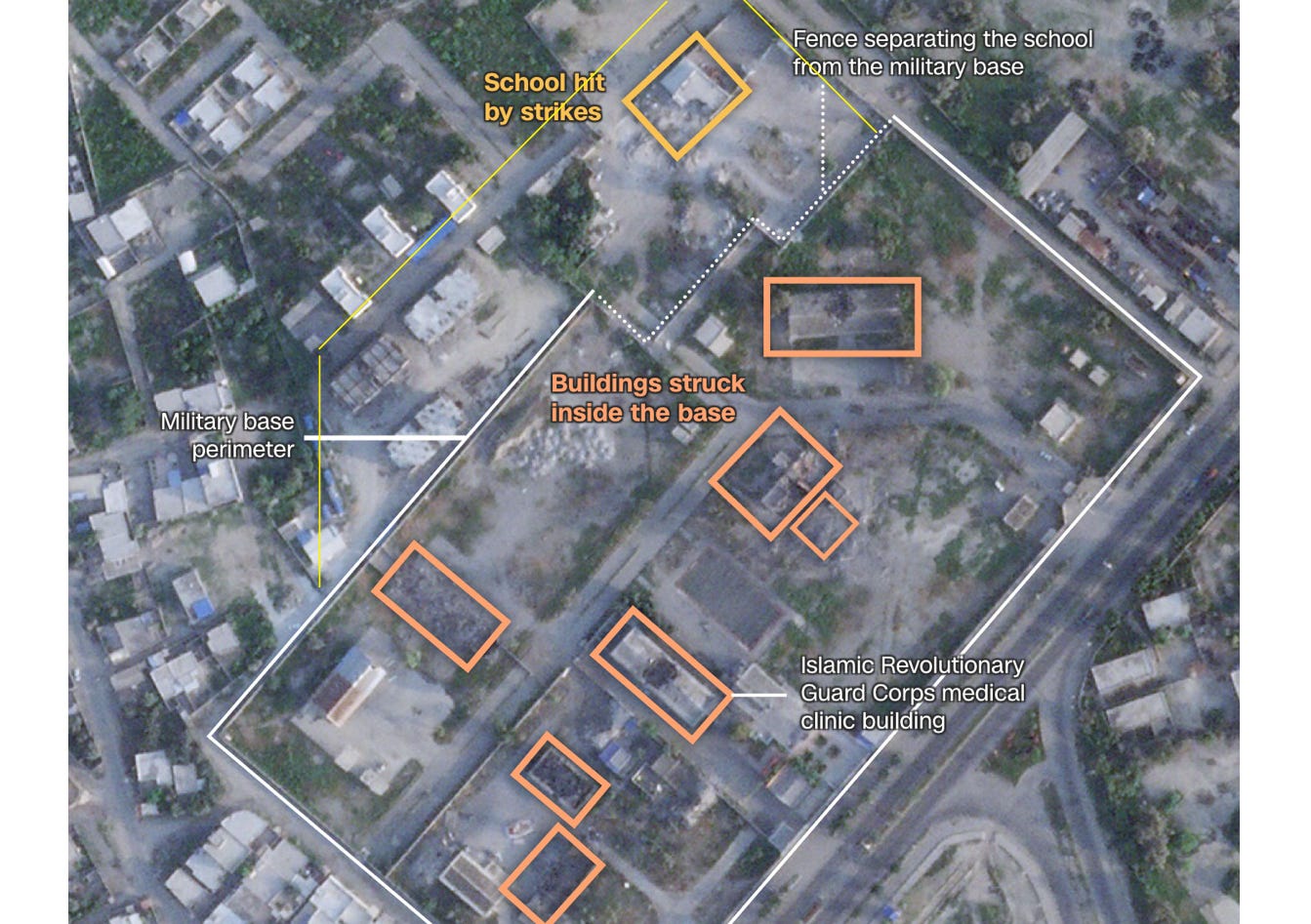
But to be perfectly clear: this was a building that was literally inside an IRGC Naval headquarters compound until about ten years ago, on property that the IRGC built, next door to an active naval brigade HQ, in the most militarily sensitive province in Iran. And the Times’ framing was that America should have known it was “a school” and avoided strikes on the base.
The Times never, ever asked why Iran was running a girls’ school on a naval base in the first place.
It gets worse. U.S. officials told the Times they couldn’t determine when the school and the base had “separated”— which is diplomatic language for “they hadn’t separated.” As the U.S. (and the Times) knew, Iran had already ordered all in-person classes suspended nationwide after strikes began. Yet somehow, at this particular school, attached to this particular IRGC base, the girls were still attending class. The Times never mentions this fact, either.
How could we possibly have known that Iran forced these particular girls, next to its most sensitive naval base, to attend school when all the other schools had been closed? That’s another question the Times never explores.
The Geneva Convention, Article 51(7), Additional Protocol I clearly states: “The presence or movements of the civilian population shall not be used to render certain points or areas immune from military operations.”
In other words, in civilized countries, keeping children in a military facility during an active shooting war has a name. It’s called using human shields, which itself is a war crime under Article 51. But the Times never asked that question, what was the good reason for having the girls in an on-base school when all other schools were closed for war. It asked not once. In dozens of breathless, accusatory articles and a brain-dead podcast.
But wait. There’s more. And this is what makes the Times’s coverage so much worse than mere negligent journalism.
🚀 The Times is accusing the United States of accidentally targeting a civilian school. But meanwhile, the Times has been conspicuously ignoring Iran’s own deliberate targeting of civilians across the Persian Gulf. Not only that. The Times has been celebrating it.
On March 3rd, the Times published a fawning analysis headlined “Iran’s Strategy: Expand the War, Increase the Cost, Outlast Trump.” The article called Iran’s campaign of bombing hotels, airports, oil refineries, water treatment plants, Amazon data centers, and cargo ships across six sovereign nations as —get this— “asymmetric endurance.” The Times approvingly quoted analysts calling Iran’s targeting of civilians as a clever plan to “spread the pain.” One expert enthused that Iran was “enlarging the battlefield.” Another called it a “test of wills and stamina.” One more would have described it as “mostly peaceful protesting.”
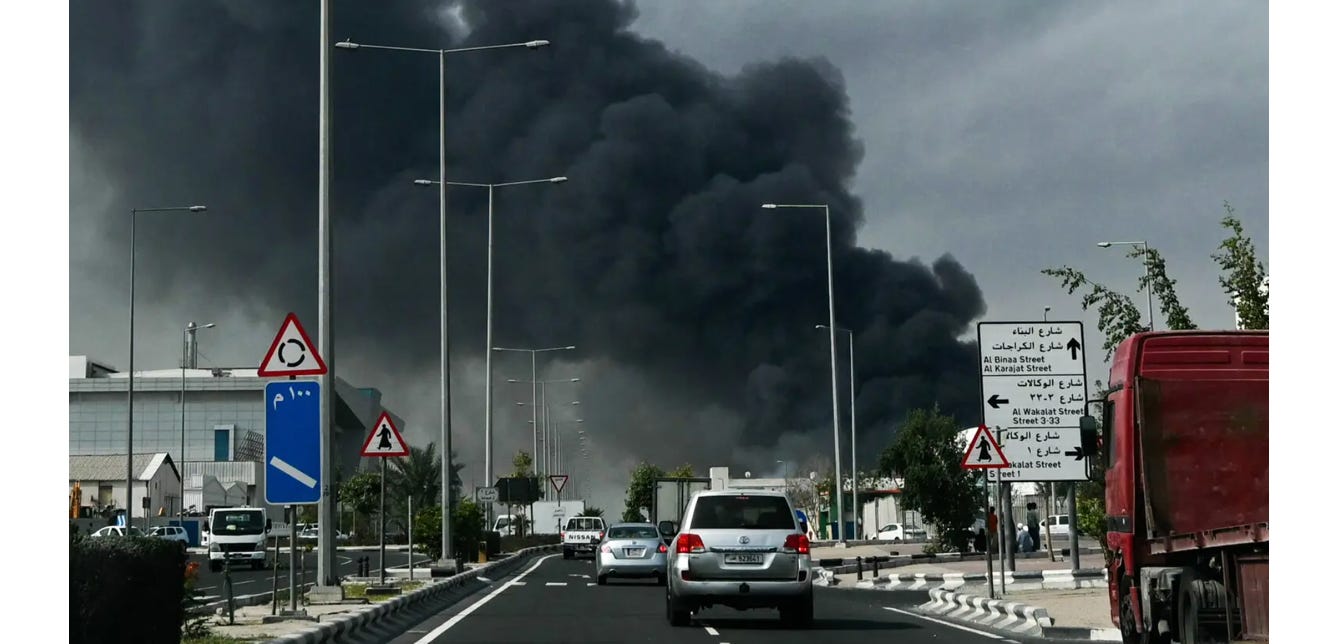
The word “war crime” has never appeared in these stories. At least, not applied to Iran.
On March 6th, the Times covered Iran’s attacks on unarmed and undefended commercial shipping under the headline “Iran’s Chokehold on Strait of Hormuz Strains Oil and Gas Shipping,” admiringly describing the bombardment of defenseless civilian vessels as “leverage over global energy flows.”
On March 10th: “Trump Tries to Sidestep Blame for Any Civilian Deaths in Iran.” (Blame was assumed.) On March 12th —yesterday— the Times published “What Is the Strait of Hormuz and Why Is Iran Blocking It?” The subheadline: “Tehran is using the world’s most important transit point for oil and gas as leverage against its enemies.”
Oh, how clever the Iranians are! They use leverage! Strategy! Asymmetric endurance! Not terrorism. Not war crimes. Leverage.
Let’s review what the Times considers to be “leverage.” Since February 28th, Iran has deliberately —not accidentally, not with outdated targeting data, but deliberately— launched missiles and drones at targets like:
Dubai International Airport (four civilians wounded)
Jebel Ali port in Dubai
A Thai-flagged cargo ship in the Strait of Hormuz, set on fire
A desalination plant in Bahrain — because apparently drinking water is a fair military objective, according to the Times, anyway
Bahrain’s only oil refinery, forced to declare force majeure
Saudi Aramco’s Ras Tanura refinery, operations halted
Qatar’s Ras Laffan LNG facility, the largest on earth
Private civilian commercial data centers in the UAE and Bahrain — believed to be the first deliberate military targeting of data centers in history
Oil refineries across five countries: Bahrain, Kuwait, Qatar, Saudi Arabia, and the UAE
Hotels. Airports. Drinking water. Offices. Data centers. Cargo ships. The world’s energy supply. All deliberately targeted. None of them “accidents.” None of them adjacent to military bases that someone ‘forgot’ to update on a target list. Iran deliberately pointed its weapons at civilian targets and mashed the button, over and over and over.
Everybody except the New York Times understands exactly what this is. The Alma Research Center said Iran was “clearly targeting civilian objectives — including residential buildings, hotels, shopping malls, airports, and ports.” Six Gulf nations issued a joint statement saying, “Targeting civilians and countries not engaged in hostilities is reckless and destabilising.”
The U.S. Ambassador to the United Nations called it out: “Iran’s practice of targeting civilians and civilian infrastructure is reprehensible. Iran is indiscriminately attacking innocent families and civilians” across eleven different countries. The UAE government said, “Targeting civilians and civilian objects is condemned and rejected by all legal and humanitarian standards.”
Even Amnesty International —not exactly a neocon think tank— said Iran’s strikes “could amount to war crimes.” And just yesterday, the military think-tank Institute for the Study of War compiled a list of Iranian strikes on peaceful civilian ships:

When Trump’s military takes out narcoterrorist submarines in the Caribbean, it’s a war crime. When Iran does it against peaceful merchant ships, it’s strategy.
Good luck finding any of those quotes about civilian strikes in the Times’s many stories or their silly podcast. It’s much worse than that glaring omission. The New York Times looked at Iran deliberately bombing hotels and airports and drinking water across half the Middle East— and crowned it strategy. Called it a “test of wills.” Clapped like mental patients.
“Asymmetric endurance.” The World’s Paper of Record overworked its thesaurus, but dropped its moral compass into the Red Sea. Bloop.
Having cheerfully reframed Iran’s campaign of civilian terror as a savvy geopolitical chess move, the Times spun around and devoted dozens of articles, a podcast episode, scores of mindless press conference questions, and weeks of righteous investigative fury to the one strike where it could blame America— one single accidental hit on a former military building, on the war’s first day, using ‘outdated’ targeting data, on a school that Iran had suspiciously kept open inside an active IRGC naval base during active hostilities.
Nobody —not even the Times’s own sources— has accused the U.S. of hitting that school on purpose. But the paper’s Magoo-like myopia apparently prevents it from seeing the exact same alleged war crimes being committed daily by Iran against other countries in the same war. Iran’s propaganda team couldn’t possibly do it any better.
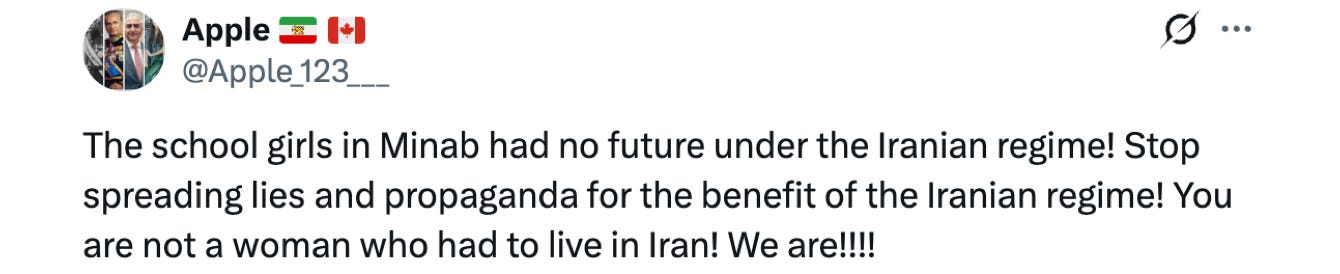
🚀 Many Iranians reacted exactly opposite to the Times’s narrative frame. An Iranian refugee in Canada called it what it was: spreading lies and propaganda for the regime:
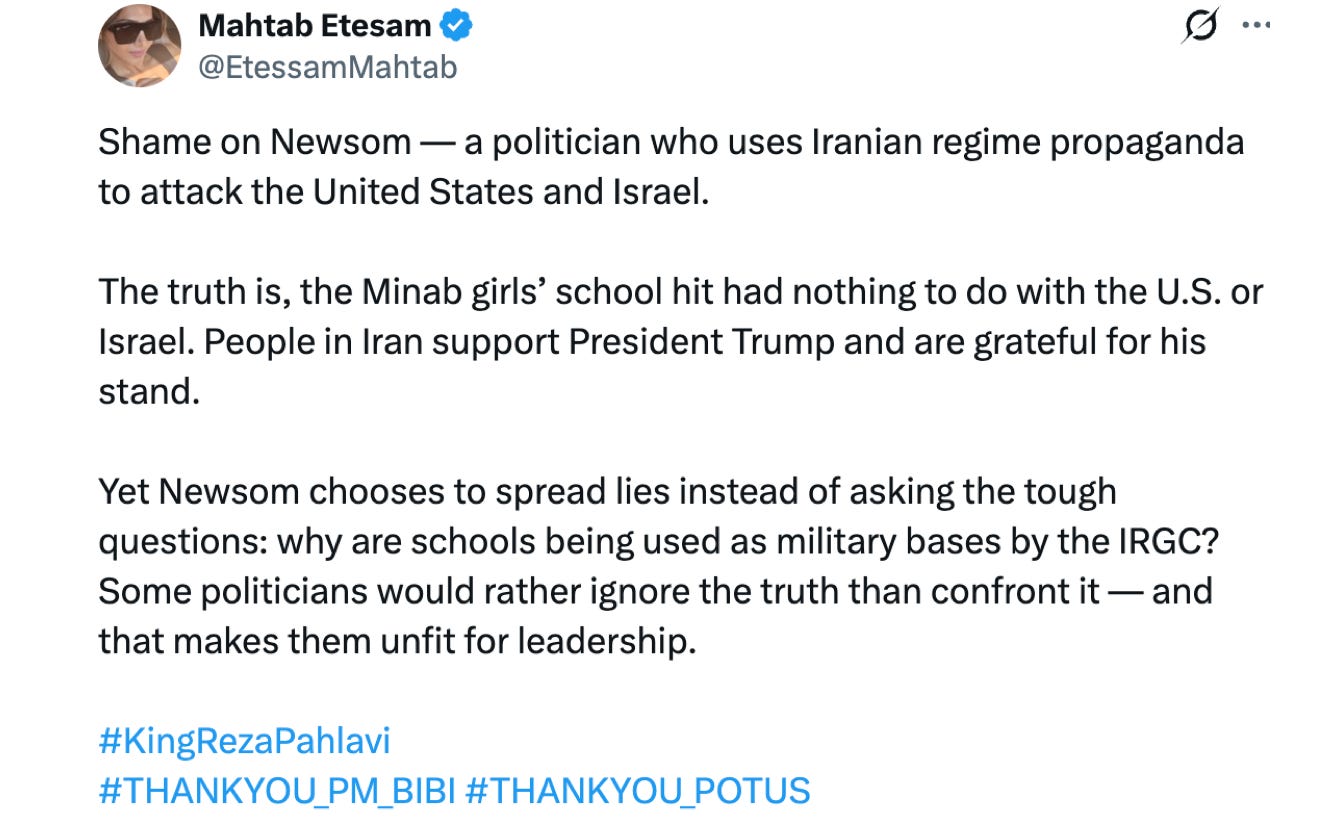
Another Iranian woman called out oleaginous Governor Newsom for parroting the Times’s propaganda:
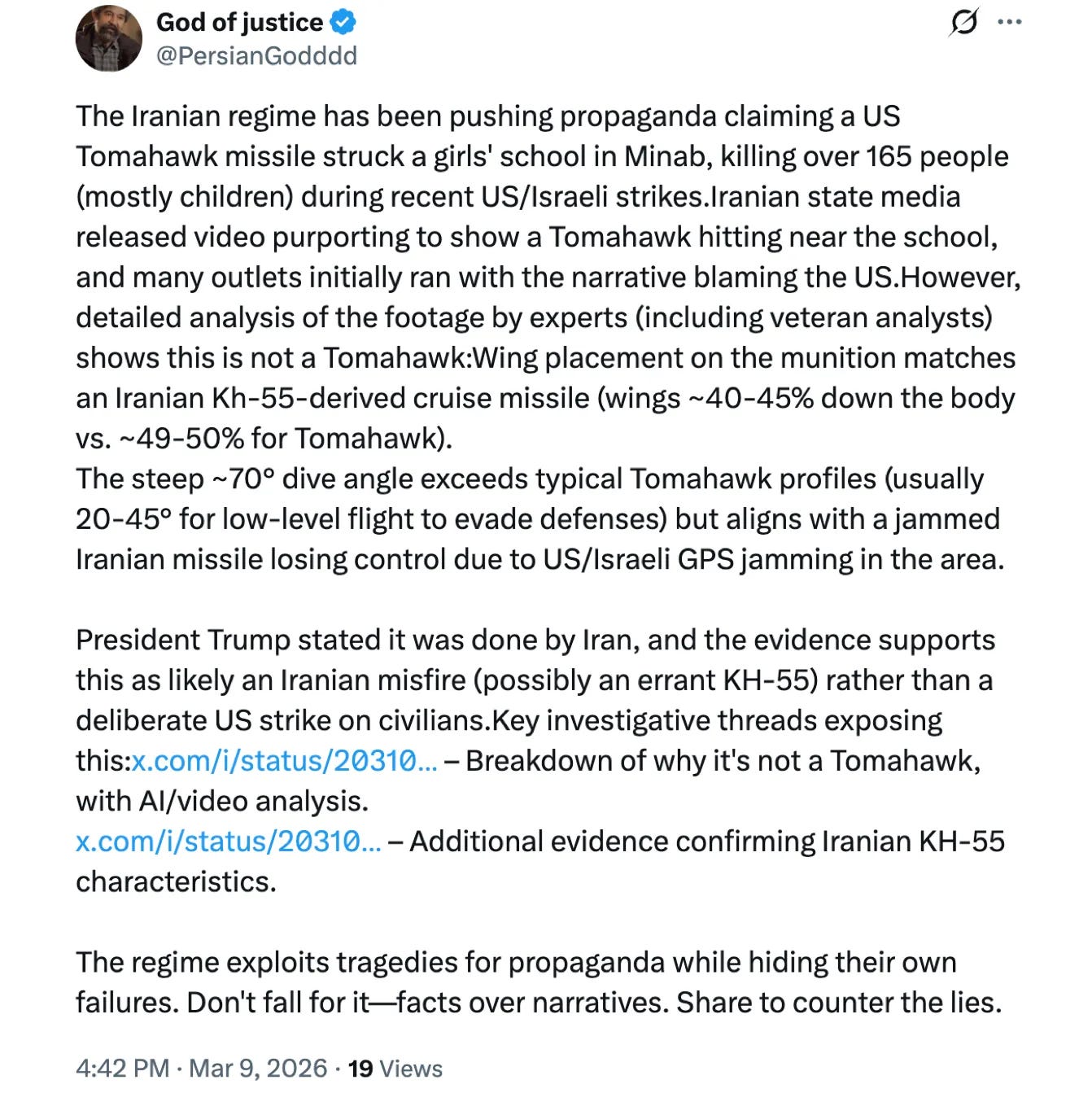
Four days ago, an Iranian warblogger made the case that the missile that struck the school was an Iranian misfire and not American:
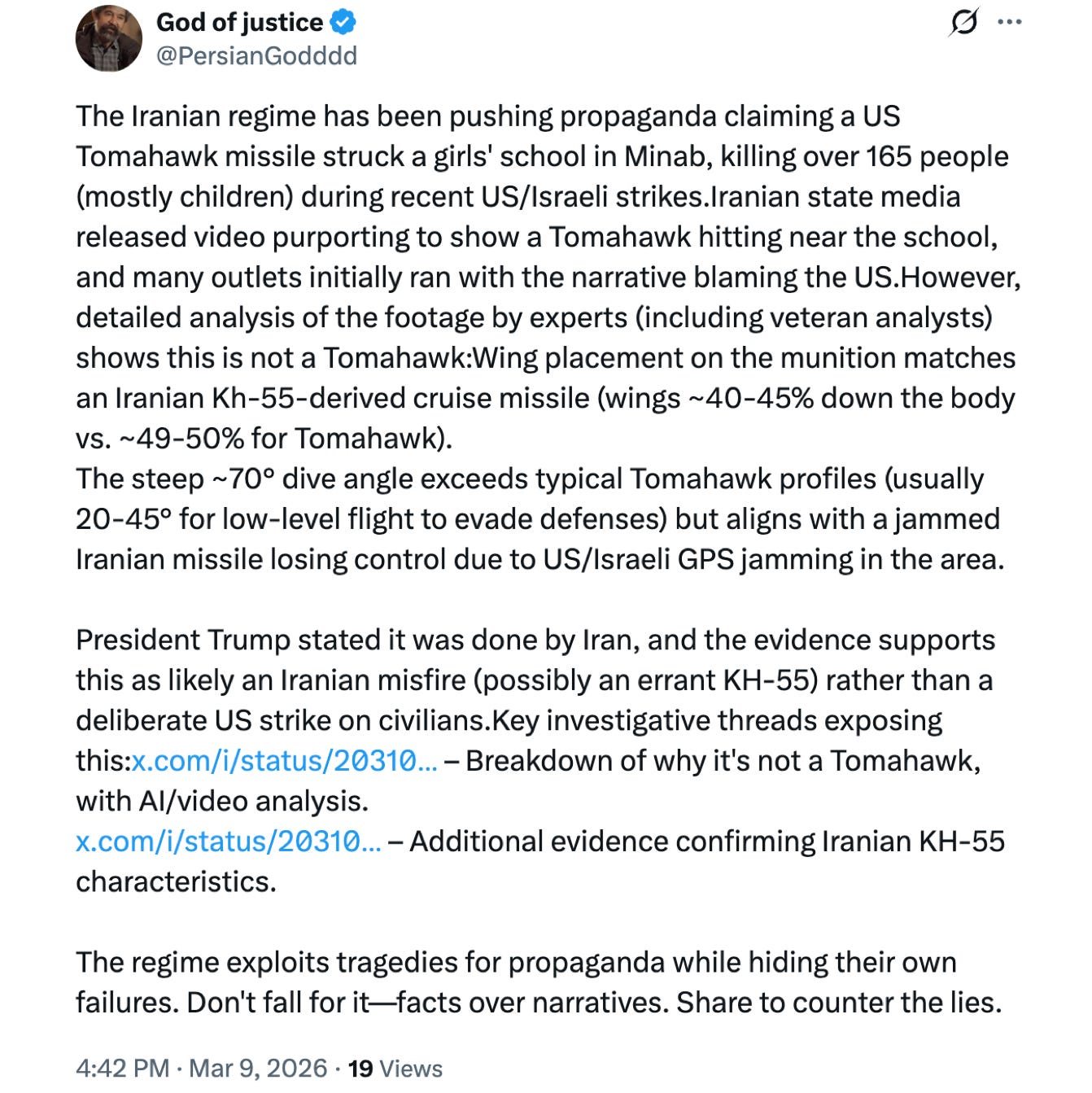
Regardless of whether @PersianGoddd is right, his post shows Iranians leaping to defend the US from the fake claim that the U.S. deliberately targeted an elementary school. There are many more. At 12:33 last night (does the man ever sleep?), even President Trump seemed to have had it with the Times’s treasonous war coverage and posted this to Truth Social:
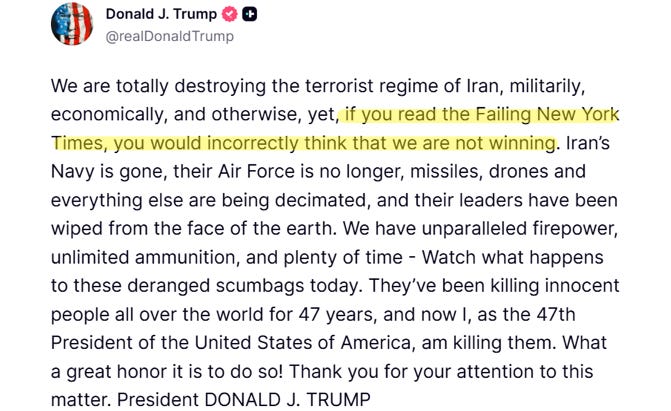
To tell you the truth, I have about had it with the Times, too. Someone should check whether IRGC, Inc. owns shares in the Grey Lady or sits on its board or something. Why is the Times carrying so much water for the invisible Iranian regime?
🚀 Speaking of Schrodinger’s Ayatollah, yesterday (March 12th), a written message attributed to Mojtaba Khamenei was read by a newscaster on Iranian state TV while they showed a still photo. No video, no audio. Just a photo and someone else reading his words. That’s it.
The Iranian public has never heard the voice of their (allegedly) new Ayatollah. We can argue about whether the guy is alive or dead, but clearly, he’s not exactly crushing it in the public relations department. It’s still Weekend at Mojtaba’s. Except you could at least see Bernie.

Over the last several days I've watched otherwise sensible people begin to support the "America bombed the school" narrative without evidence, without citing named sources, and without thinking through that Iran is just as capable of lying about a war crime as any other combatant particularly as it bombs civilians in war crimes of its own. Whatever happened to supporting the US first before convicting it of committing war crimes? Why so much sympathy for the Iranian government that has treated its citizens so brutally when in the US, citizens have freely exercised their freedom of speech without consequences every time they scream "F..k Trump"?
So the whole thing may be a load of bollocks as I might put it bluntly. Of course even missles can go AWOL and might be interferred with by ECM and come down where they shouldn't.
Dug graves reminds me of the supposed graves for all the COVID victims in New York in 2020. That was load of tosh.
As to the New York Times, it believes in COVID etc. It's as trustworthy as a rattlesnake. And I see that 'New York Times' anagrams to:
- skew enormity
- er my wonkiest
- I worst key men
- monkeys write
If monkeys write enough one day they may get something right. :<)
An Infinite Number of Monkeys
Bob Newhart
https://www.youtube.com/watch?v=Ngmf8G5xKas